Converting an urban site
A food desert is a logistics problem. Solve it with geography.
Produce grown five states away arrives tired, expensive, and with the profit already extracted by everyone who touched it. Convert a rooftop, a vacant lot or an empty building and the food is grown where the people are — and the operating profit stays in the community instead of the supply chain.
Where you are now
We have heard this from every site like yours.
If none of this sounds like you, you probably do not need us — and we will tell you that on the call rather than sell you a system.
Fresh food arrives last and costs most
The neighbourhoods with the least access pay the most for the oldest produce. The freight, the packing house and the warehouse all take their cut first.
There is no soil and no space
Vacant lots, rooftops, parking structures and empty buildings are not farmland. Traditional growing needs land a city does not have.
Programmes have to show outcomes
Grants and civic capital need reportable results: pounds grown, jobs created, dollars retained locally.
What it becomes
What this site becomes.
Soil-free means site-free
Because nothing touches the ground, a rooftop, a warehouse, a parking deck or a lot with contaminated soil all become viable growing sites. The site stops being a reason not to grow.
The profit stays put
Local production keeps the operating margin in the community rather than handing it to the logistics chain that moves food from farm to packer to warehouse to shelf.
Safe, teachable work
No heavy machinery, no chemicals, no tilling. The system is safe enough to be operated by a school, a co-op or a training programme.
A real grocery list, not one crop
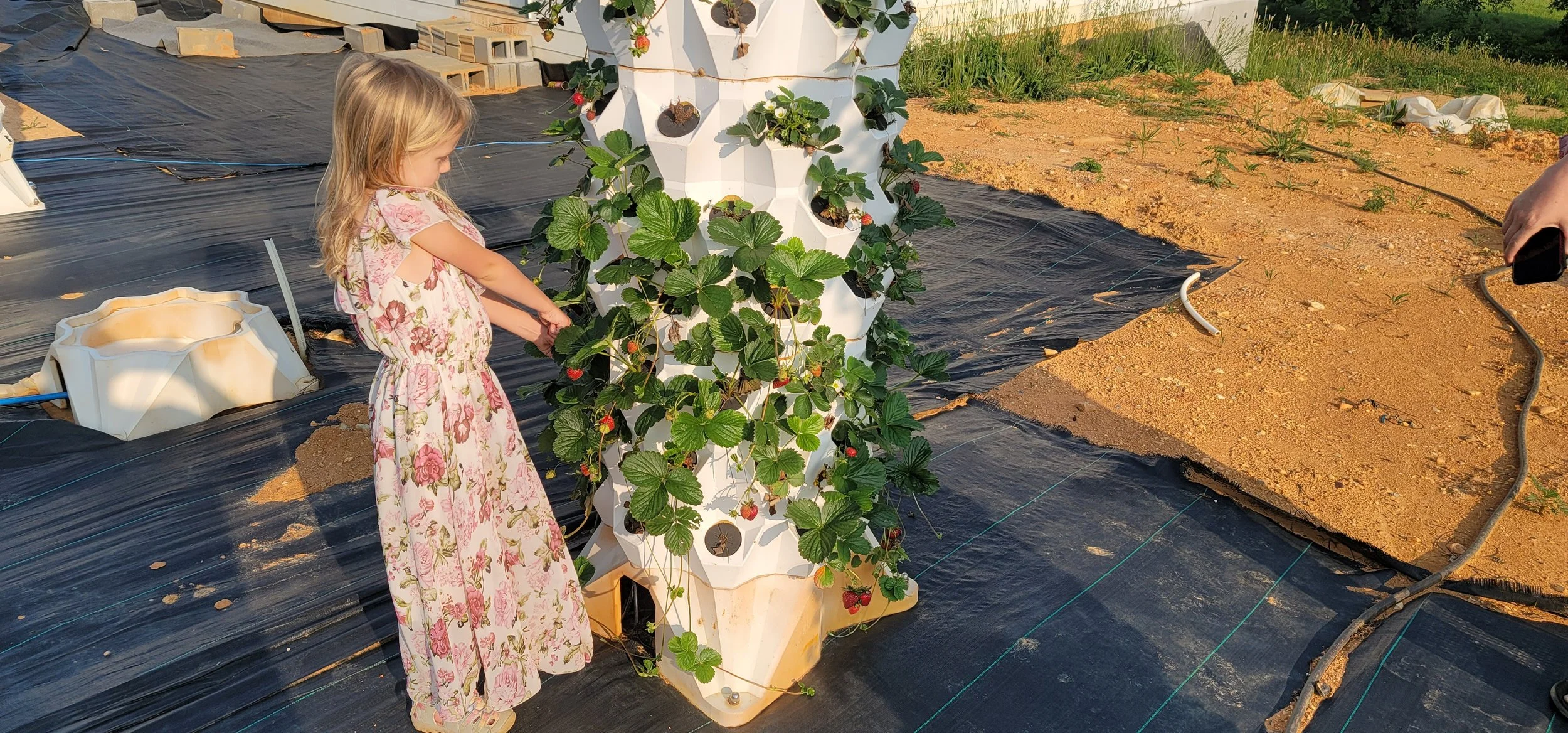
Each pod is dosed on its own recipe, so a single site grows strawberries, lettuce, kale and spinach at the same time. A neighbourhood needs a shop, not a monoculture.
Countable outcomes
Every tower is 108 plants and a known cycle. Yield, jobs and dollars retained are numbers you can put in a report.
How the conversion runs
We design it and supply it. Your crew builds it.
No foundations, no soil, no heavy machinery. A conversion is plumbing and assembly against a drawing we make of your building.
We survey the site
Square footage, ceiling height, power, water source, drainage, floor condition and what is already standing in the way. Photographs and a walk-through, not a form.
We engineer the layout
Pod count, pod size, tank placement, manifold runs, tower spacing and the crop plan that fits your market. You get a drawing of your building with the Produce Factory in it.
We supply the system
Towers, tanks, pumps, manifolds, nozzles, sensors and the monitoring software — manufactured in America and shipped to a schedule you can plan a build around.
Your crew builds it
Your team or your contractor does the install, against our drawings and with our engineers on the phone. It is plumbing and assembly, not a construction project — no foundations, no heavy machinery, no soil.
We commission and train
We bring the system up, dial in the nutrient recipes per pod, and train whoever is going to run it. Then it is yours — and we are still on the phone.
Where sites like yours start
The Commercial system — 2–4 pods.
~48 towers, 5,184 growing sites. Fits inside an existing greenhouse bay. A pod is one central tank with its own pumps and its own nutrient recipe — so two to four crops at once.
- ✓Everything in Field Block
- ✓Each pod dosed independently — a different crop in every zone
- ✓Staggered harvests across pods for level weekly supply
- ✓Priority parts and remote diagnostics
The consult
Bring your site. We will bring the drawing.
Bring your site, your funding structure and the outcomes you have to report. We will help you build the case.
Thirty minutes, no slides, and an honest answer at the end of it — including “this site will not work,” if that is the honest answer.
Book a Grower ConsultNot what you have?
Industrial & Warehouse
It already has power, water and a roof. It is a farm that has not been told yet.
See the conversion →Greenhouse & CEA
You already control the climate. You are just not using the height.
See the conversion →Working Farmland
You cannot out-acre the industrial farms. You can out-margin them.
See the conversion →Find out what your square footage is actually worth.
A 30-minute grower consult. Bring your site, your crop and your buyers — we will tell you what it becomes as a Produce Factory, and whether the numbers work.